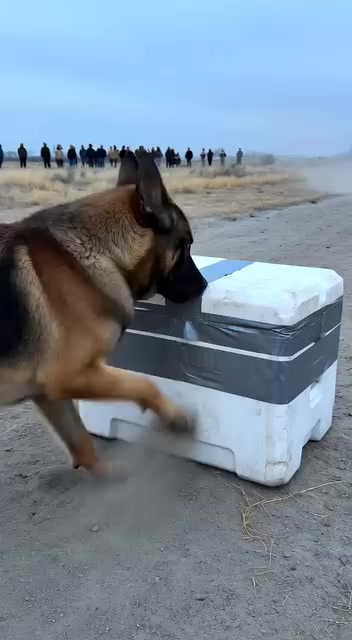
“My K9 Bandit Wouldn’t Stop Tearing At A Discarded Cooler In Front Of 300 People… What I Found Inside Left Me Questioning Everything I Knew About Humanity.”
I’ve been a K9 handler at the Texas border for years, but nothing—absolutely nothing—could have prepared me for the moment Bandit tore into that white styrofoam cooler in front of three hundred silent witnesses.
It was 104 degrees in the shade, though there wasn’t any shade to be found in Sector 4. The air was a thick soup of dust, diesel exhaust, and the heavy, stagnant scent of too many people packed into too small a space.
Three hundred refugees and migrants stood in a jagged line, their eyes hollowed out by exhaustion, watching us. They watched the way I gripped Bandit’s lead. They watched the way Bandit’s ears shifted, scanning the frequencies of the desert wind.
I’ve had Bandit for 215 days. In the world of K9 units, that’s not just a partnership; it’s a soul-bond. I know the twitch of his tail. I know the specific pitch of his whine when he smells high-grade narcotics versus the low-frequency growl he gives when he senses a human hidden in a floorboard.
But today, Bandit was different. He wasn’t just alerting. He was frantic.
We were moving past a pile of discarded supplies—cheap backpacks, empty water jugs, and a single, oversized styrofoam cooler wrapped in layers of silver duct tape.
Bandit stopped dead. His nose hit the seam of that lid, and he let out a sound I’d never heard before. It was a high-pitched, guttural scream, a mix of a bark and a sob.
“Easy, boy,” I whispered, my hand moving to my holster instinctively. The crowd behind the fence went dead silent. Three hundred pairs of eyes locked onto us. You could hear the wind whistling through the chain-link.
Bandit didn’t sit. He didn’t give the ‘passive alert’ he was trained for. He began to shred the foam. White flakes flew into the air like a grotesque snowstorm in the middle of the Texas heat. He was whimpering, his claws digging into the tape, desperate to get inside.
My heart was hammering against my ribs like a trapped bird. I stepped forward, pushing Bandit back with my thigh. I pulled my multi-tool, the blade catching the harsh, flat light of the afternoon sun.
“Back up!” I shouted to the nearest group of men by the fence. They didn’t move. They just stared, their faces unreadable, some of them crossing themselves.
I sliced through the first layer of tape. Then the second. The screech of the adhesive pulling away from the foam sounded like a gunshot in the silence.
I gripped the lid and yanked.
For a second, my brain couldn’t process what I was seeing. I expected bricks of white powder. I expected stacks of diverted currency. I expected the cold, hard tools of the cartels.
Instead, I saw a shock of matted dark hair.
Nestled inside the cramped, suffocating darkness of that foam box was a baby. He couldn’t have been more than six months old. He was wrapped in a thin, grimy blanket, his skin a terrifying shade of porcelain gray.
But he wasn’t crying. He wasn’t moving.
“Medics! I need a bus over here now!” I roared into my shoulder mic, my voice cracking.
I reached in, my gloved hands shaking as I lifted the tiny, limp body. The baby’s head rolled back against my arm. I pressed two fingers to his neck, praying for a pulse, for any sign that the Texas heat hadn’t claimed him.
There. A faint, thready beat.
I looked closer at the baby’s arm. There were small, blue bruises—needle marks. My blood ran cold. The smugglers didn’t just hide him; they’d injected him with opioids to keep him quiet for the journey. They’d turned a living soul into a piece of luggage.
The crowd began to murmur, a low, rising tide of anger and grief. I felt a surge of protective fury so strong it made my vision blur.
“Bandit, watch,” I commanded. The dog stood over the empty box, his teeth bared, guarding the perimeter while I cradled the boy.
Then, I saw it.
Lying at the bottom of the cooler, where the baby’s feet had been, was a standard plastic baby bottle. It was half-filled with a thick, yellow liquid. At first, I thought it was spoiled formula.
But as the sun hit the plastic, I saw something shimmering inside the liquid. Something metallic. Something that didn’t belong in a nursery.
I reached back into the box and pulled the bottle out. It was heavy—far too heavy for a few ounces of milk. I unscrewed the cap, and the smell of ozone and chemicals hit me instantly.
I poured a bit of the liquid onto the dirt. It hissed.
And then, I saw what was hidden at the bottom of that bottle. It wasn’t just a discovery. It was a death sentence for whoever had left this child here.
Read the full story in the comments.
If you don’t see the new chapter, tap ‘All comments’.
Source