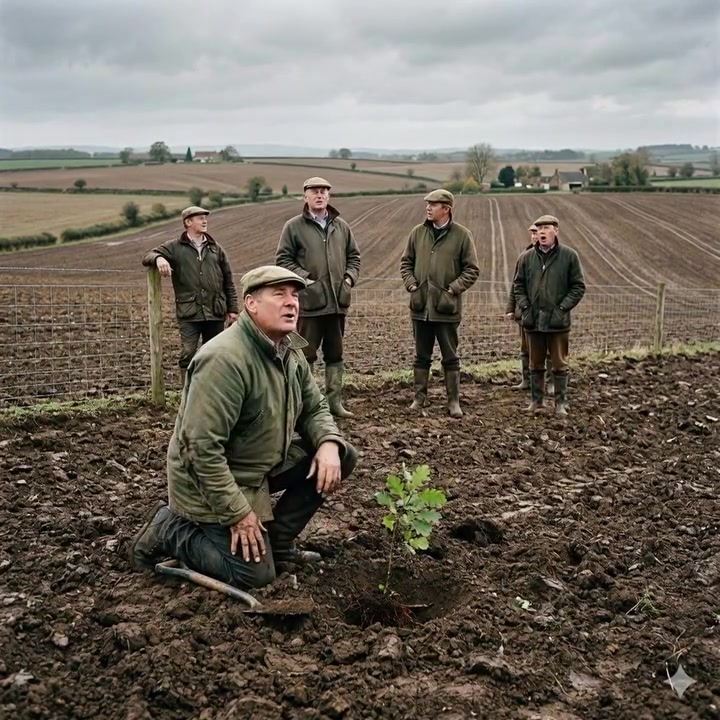
They Laughed at His Trees for Years. Then Came the Night That Silenced Everyone.
For years, people in Willow Creek thought Thomas Hale had lost his mind.
It started with the trees.
Not just planting them—anyone could do that—but the way he planted them. Rows that curved instead of running straight. Clusters arranged in strange, uneven patterns. Thick belts of evergreens surrounding open fields like protective walls.
“Looks like a maze,” one neighbor joked.
“Or a forest that doesn’t know what it wants to be,” another added.
Thomas never argued.
He would simply nod, adjust his worn cap, and return to his work.
Because to him, the trees weren’t random.
They were a system.
Willow Creek was a quiet farming town tucked between rolling hills in Kansas. The land was fertile, the people practical, and the traditions deeply rooted. Farmers planted crops in neat, predictable lines. Fences ran straight. Windbreaks—if they existed at all—were simple rows of trees placed along the edges of fields.
Not spirals.
Not clusters.
Not… whatever Thomas was doing.
“Why not just do it the normal way?” his neighbor, Carl Benson, asked one afternoon, leaning on the fence as Thomas dug another hole.
Thomas wiped dirt from his hands. “Because normal doesn’t stop everything.”
Carl snorted. “Stop what?”
Thomas glanced at the horizon.
“The wind,” he said simply.
Carl laughed. “You planning to fight the sky now?”
Thomas didn’t answer.
Because in a way, he was.
The idea hadn’t come out of nowhere.
Five years earlier, a storm had torn through Willow Creek without warning. It wasn’t a tornado—at least, not officially—but the winds had reached terrifying speeds. Crops were flattened. Roofs were damaged. And Thomas…
Thomas had lost almost everything.
His farmhouse had survived, barely. But his fields were stripped bare, soil blown away in places, leaving behind patches of dry, lifeless ground.
He remembered standing there afterward, staring at what remained.
Not just loss.
Failure.
He had followed every rule. Done everything “right.”
And it hadn’t been enough.
So he started studying.
Wind patterns. Soil erosion. Forestry techniques.
He spent nights reading, days experimenting. He learned how certain tree species could slow wind, how layered vegetation could break gusts into smaller, less destructive currents. He studied old agricultural practices, even techniques used in desert regions to prevent sandstorms.
And slowly, an idea formed.
What if the land itself could be shaped to resist the storm?
Not by fighting it head-on—but by redirecting it.
The first year, he planted a ring of fast-growing trees around his property.
People thought it was odd, but harmless.
The second year, he added inner rows—curved lines of mixed species, spaced deliberately to create varying heights and densities.
That’s when the comments started.
“Planning to get lost in your own farm, Tom?”
“You building a park or something?”
By the third year, the laughter was constant.
Because now, the pattern was undeniable.
From above, his land looked nothing like the others. It wasn’t neat or orderly. It was chaotic—almost wild.
But Thomas knew better.
Every tree had a purpose.
Every curve, a reason.
“Those trees are gonna steal all your water,” Carl said one morning, watching Thomas plant another sapling.
“They’ll hold the soil,” Thomas replied.
“They’ll choke your crops.”
“They’ll protect them.”
Carl shook his head. “You’re betting your whole farm on this?”
Thomas paused, pressing the soil firmly around the base of the young tree.
“I’m betting it on not losing everything again,” he said quietly.
Years passed.
The trees grew.
Tall. Strong. Interwoven.
From a distance, Thomas’s land began to look like a small forest, broken only by pockets of cultivated fields nestled between the greenery.
And something else happened…..
… read full story in the 1st comment 👇👇👇
Source