[ad_1]
In 1979, when Richard Miller buried his wife, the house went quiet in a way that felt permanent.
No footsteps in the hallway.
No soft humming in the kitchen.
No whispered plans about the children they never got to have.
Anne had been sick for months. In her final days, she held his hand and said something he didn’t fully understand at the time:
“Don’t let love die with me. Give it somewhere to go.”
After the funeral, friends urged him to remarry. Start over. Find someone younger. Fill the silence.
But Richard didn’t want to replace love.
He wanted to honor it.
One night, as rain battered the city and sleep refused to come, he found himself driving without direction. The road led him past St. Mary’s Orphanage — a place he and Anne had once talked about visiting.
The lights were still on.
He went inside.
And that’s when he heard them.
Nine babies.
Crying.
Not one.
Not two.
Nine infant girls, abandoned together, their bassinets lined up like a row of unanswered prayers.
They had been left at different hospitals, different doorsteps, different stories — but all with the same ending.
No one wanted them.
And no family was willing to take all nine.
“They’ll have to be separated,” a tired social worker told him gently. “It’s the only practical solution.”
Richard walked slowly past the bassinets.
Tiny fingers curled in the air.
Nine pairs of eyes that didn’t yet know the world had already rejected them.
He bent down.
His voice trembled.
“I’ll take them,” he said.
The room went silent.
“All of them.”
The reaction was immediate.
You’re grieving.
You’re unstable.
You can’t handle this.
It’s impossible.
And underneath the practical concerns was something uglier:
“What’s a white man doing raising nine Black girls?”
Richard heard every whisper.
And signed the papers anyway.
He sold Anne’s jewelry.
Took extra shifts.
Learned how to braid hair by watching borrowed VHS tapes.
Built nine cribs with his own hands in a house that had once felt too empty.
The first year nearly broke him.
Nine bottles.
Nine fevers.
Nine nightmares.
Nine tiny voices calling “Daddy” in overlapping chaos.
He fell asleep sitting up more times than he could count.
But love — the kind Anne had spoken of — didn’t divide.
It multiplied.
Sarah’s laugh filled rooms.
Naomi tested every boundary.
Leah held her sisters’ hands when thunder scared them.
Grace sang.
Hannah asked questions about everything.
One by one, they formed a constellation around him.
There were hard years.
Money was tight.
Strangers stared.
Teachers made assumptions.
But inside that house, there was warmth.
There were bedtime stories about a woman named Anne who believed love should never be wasted.
There were birthday cakes with nine candles.
There were braiding sessions under kitchen lights.
There were hugs that nearly knocked him over.
The world had said no to them.
Richard had said yes.
And now, forty-six years later, in 2025, Richard sits at a long dining table surrounded by nine women who call him Dad.
A teacher.
A pediatric nurse.
A lawyer.
A social worker.
A small business owner.
Mothers themselves.
The same girls no one wanted.
Now pillars of their communities.
The whispers have long faded.
What remains is a legacy built not from blood — but from choice.
Richard looks at the women laughing around his table and sees what Anne meant.
Love did not die with her.
It grew.
And what those nine little girls became 46 years later is something no one in 1979 could have imagined.
See where they are now — full story in the first comment 👇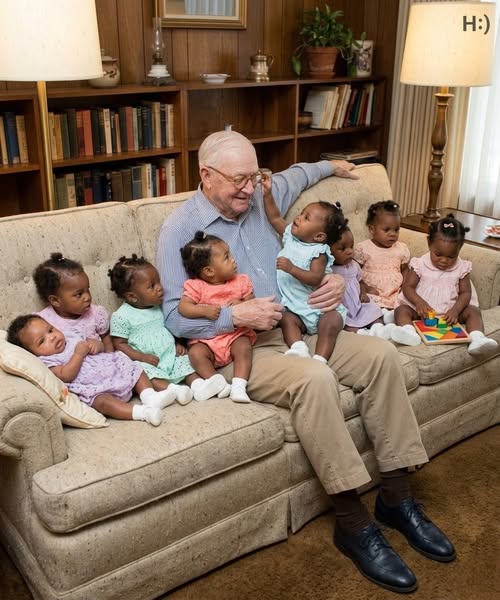
[ad_2]
Source
In 1979, when Richard Miller buried his wife, the house went quiet in a way that…